Ariadne “Nitza” Deamantopulos was born in Chicago on March 23, 1908 to Greek parents Emily (née Mermingas) and George Deamantopulos (sometimes spelled Deamantopoulos). George had immigrated to Chicago in 1893 at the age of 20 and was naturalized in 1898. He was a successful merchant, running confectionary and fruit stores and expanding into real estate and construction with his brothers. Together, George and Emily had six children: three girls and three boys.
In 1920, when Nitza was twelve, the family moved from Chicago to Vestina, a village outside of Sparta in Greece where George and Emily had been born. Nitza often recalled how, when they arrived in Sparta, her father was anxious to reach his village even though it was nightfall. Leaving Emily and the youngest children in Sparta, George and his three older children traveled to Vestina. They rode on donkeys (or perhaps in a wagon), journeying together through the night to the mountain village. Nitza remembered reaching Vestina as the early morning light drenched the village in beautiful sunrise colors. This experience may have inspired her appreciation for color and light that led to her career as an artist.

Emily and the children remained in Greece for ten years, while George returned to his business ventures in Chicago. This was a common practice among Greek immigrants who found financial success in the United States, and many sent their children back to Greece for security and education. The roaring twenties were a dangerous time in Chicago, especially during Prohibition. In addition to successful confectionary and fruit businesses, George probably also participated in bootlegging. A commercial building that he built in Jefferson Park has unique basement closets narrow enough to hold stacked whiskey and wine barrels that would have been hidden behind mounds of coal. George also served on the Parish Council of the Annunciation Greek Orthodox Cathedral of Chicago throughout the 1920s.
With business in Chicago booming, the Deamantopulos children were sent to private schools in Sparta and Athens. Nitza and her sisters attended Hormoose (XOYPMOYZH) finishing school in Athens, where their studies included painting, cooking, literature, and language (including German and French), and piano. The school offered the girls many opportunities to experience Greek culture and society of the 1920s and it was here, surrounded by the classical works of ancient Greece, that Nitza began to take private art classes.
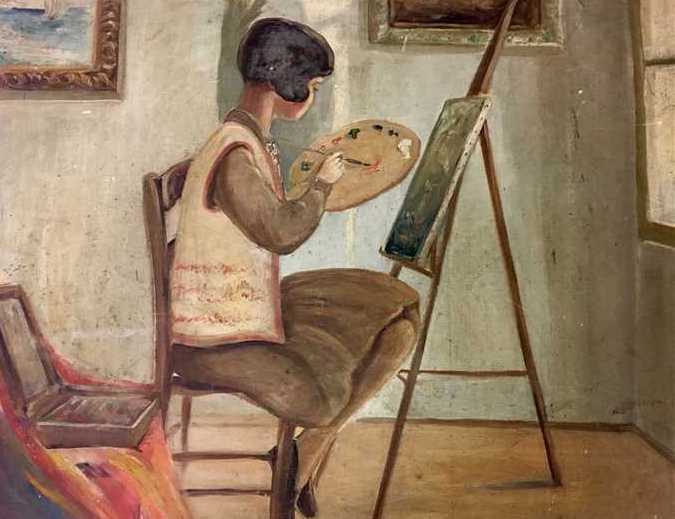
With the onset of the Great Depression, George’s ventures struggled and the family returned to the United States. Back in Chicago, Nitza pursued her artistic studies over her other interests, including classical piano, as she saw art as a more marketable skill. She showcased her work at the Outdoor Picture Mart at the Century of Progress in 1933. She also attended the School of the Art Institute of Chicago (SAIC) and took classes with celebrated Chicago artist Ivan Le Lorraine Albright. While at SAIC, she was exposed to a wide variety of European artists and styles and began to work on landscapes, still lifes, portraits, and figure studies. In 1940, Albright juried the First Annual Greek-American Art Exhibition of Chicago and included two of Nitza’s artworks: “Still Life” and “Rehearsal”. Around this time, she also began working as a professional artist at the Curt Teich Postcard Company in Chicago alongside her sister, Chrysanthy.
Curt Teich was one of the largest postcard printers in the world, primarily producing images of American life. During World War II, the company was also involved in printing over three million maps for the War Map Department. With men drafted into service, women artists like Nitza were hired to assist with production – and were bound to secrecy. Employees were required to purchase their own equipment, including air brushes. Nitza’s air brush and ink bottles, purchased for her job with Curt Teich, are now part of the Newberry Library’s Curt Teich Collection.
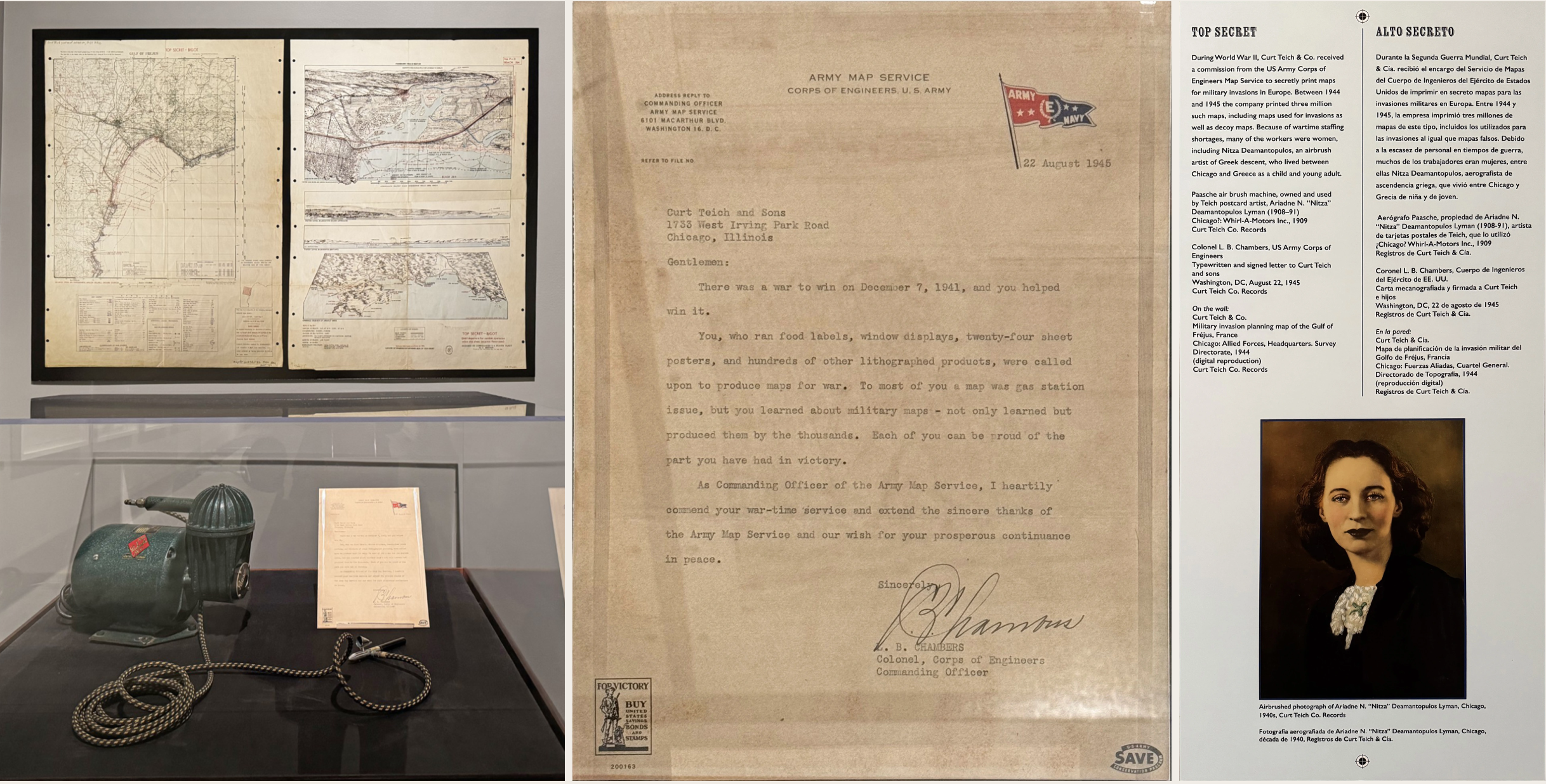
Although women were hired in large numbers during the war, policies changed once the war ended and women often lost their jobs when they married. After Curt Teich, Nitza worked at Vogue Wright Studios, a catalog photography studio in Chicago that provided graphics and illustrations for retailers and publications. However, when Nitza became engaged to Glenn A. Lyman, a retail advertising manager at the Chicago Tribune, she was told her services were no longer needed. The couple were married on January 21, 1950.
After her marriage, Nitza worked as a freelance artist colorizing and touching-up photographs, many for families who had lost loved ones in the war. Nitza mentioned how gratifying it was to receive a Thank You from a client for colorizing a photo of their son who had died in the war. As with many others, the war had left scars on her family: Nitza was conservator of her brother, Peter, who suffered from post-traumatic stress disorder (PTSD) as a result of his army service in Africa.
Many of Nitza’s family members were artists including her sister, Chrysanthy D. Sessions, who was married to renowned watercolor artist and illustrator James Milton Sessions. In her later years, Nitza continued to paint portraits (requested by family members) and took regular art classes at DePaul University. One of her drawings was exhibited at DePaul University’s Lincoln Park campus. She loved to bake and arrange flowers picked from the backyard of the building at 457 W. Melrose Avenue that she co-owned with Chrysanthy. Nitza passed away in her 80s at her home in Chicago, having led an enriching and fulfilling life.

 NITZA D. LYMAN